

Texas Data Centers and the Rising Standard of Proof
The Shift from Growth to Governance in Policy, Process, and Local Permission
January 26, 2026
2025 was acceleration and visibility. 2026 is governance.
Large-load growth brought more headlines, more scrutiny, and more organized local pushback. Now the system is responding through policy, process, and local regulation.
Over the past year, we have watched the Texas data center conversation change quickly. This wasn’t a slow, gradual shift. It was a light-speed swing in the public and policy mindset.
But what started as a story defined by growth, speed, and megawatts is now becoming a story defined by governance, conditions, and local scrutiny.
At the same time, we are watching the industry itself beginning to catch up to the reality that local permission matters. You can see it in the growing number of job postings for community managers, local affairs roles, and stakeholder engagement leads across the sector. This is a good sign, but also an indicator that many are playing catch up.
This shift is showing up across the state in real time, from ERCOT process changes to PUCT activity to the tone of local hearings and council meetings.
The “new normal” is now widely understood: data centers are here, and the demand is not slowing down.
The question we are asking at Coover | Goss is: What comes next?
Not just in terms of development volume, but in terms of how projects get approved, how they interconnect, how they operate, and how they earn and maintain permission in the communities where they locate.
At Coover | Goss, we work with developers on the ground in real communities dealing with real approvals. From that vantage point, the next phase of Texas data center development will not just be defined by whether projects can be built. It will be defined by what developers must prove - to the grid, to local leaders, and to the public - in order to build responsibly and at scale.
2025 WAS AWARENESS. 2026 BECOMES GOVERNANCE.
In 2025, the dominant dynamic in Texas was acceleration, but it was not just growth in project volume. It was also growth in visibility. We documented these trends in our annual 2025 Year in Review report here.
Large-load announcements multiplied. Site selection activity expanded beyond the traditional metro corridors. Headlines increasingly focused on the scale of these projects, the pace of development, and the early signs of local friction that came with it.
As that visibility increased, we also saw a clear shift in community response. In more places, organized pushback began forming earlier in the process. Public meetings became more frequent. Local officials began asking harder questions, sooner. In some cases, projects faced delays, increased scrutiny, withdrawn applications, or denied zoning requests as communities worked to understand what was being proposed and what it would mean for local infrastructure, water, and quality of life.
That escalation has not slowed down. It is continuing to evolve, and it is spreading. What starts in one community often becomes a reference point in the next, especially as local stakeholders share information across regions and as the broader media cycle pays more attention to these dynamics.
In 2026, the environment is changing further. The core change is not sentiment alone. It is structure.
Texas is entering a governance phase, where:
grid interconnection is treated as a statewide planning and reliability issue, not just a private development process
policymakers are working to reduce speculative queue behavior and require clearer commitments earlier
local governments are updating zoning, tax abatement expectations, and operating conditions to match a more visible and politically salient asset class
This is not Texas shutting the door. It is Texas raising the bar. Texas leadership wants data centers, but power constraints, infrastructure demands, resource limits, and constituent buy-in are now part of the equation.
“Texas data center development will not just be defined by whether projects can be built. It will be defined by what developers must prove.”
POLICY MOMENTUM: INTERCONNECTION IS BECOMING CONDITIONAL
The policy story most people are tracking is large-load interconnection. The details matter, because the policy trajectory is not abstract. It changes how projects move.
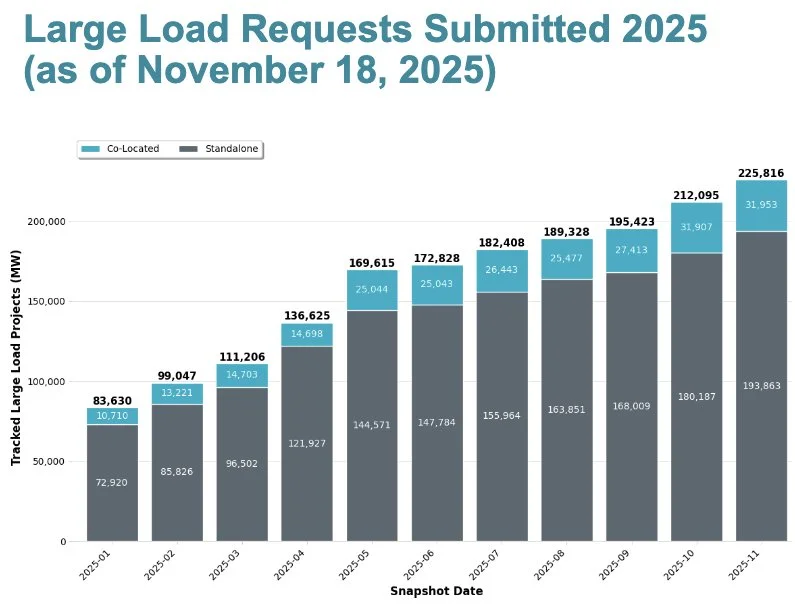
Texas Senate Bill 6 (SB 6) created new requirements and oversight frameworks tied to large-load interconnection and reliability. The direction of travel is consistent: large loads will be expected to demonstrate more readiness, more commitment, and more operational clarity earlier in the process.
In parallel, ERCOT continues to revise and formalize large-load interconnection processes. This is happening in the context of a queue environment that has drawn increasing scrutiny and public attention.
State leaders have also begun describing the scale of demand in more direct terms. Representative Ken King has noted that “we have single customers coming to Texas with an electric demand that surpasses the size of cities’ needs,” underscoring why large loads are now treated as a statewide reliability and planning issue, not just a private development matter.
What this means for developers is straightforward:
timelines will be harder to compress through optimism alone
projects will need to show credible sequencing, not just ambition
financial commitments and deposits will matter more
curtailment and operational flexibility will move from optional to expected in many conversations
A key point that is often missed is how policy tightening changes the local environment.
Communities interpret state action as a signal. When the state adds guardrails, local leaders and residents tend to assume those guardrails exist for a reason. That perception shifts baseline expectations in local hearings, meetings, and approval conversations.
The net result is a higher burden of proof. Developers will not only need to navigate the interconnection process. They will increasingly need to explain it.
”Projects with realistic sequencing, disciplined interconnection posture, and a clear operating plan will move faster than speculative or vague proposals.”
THE SORTING EFFECT: THE MARKET WILL REWARD CREDIBILITY
Texas remains an attractive market for data center development. That is not changing. But the conditions for moving from “project concept” to “project reality” are shifting.
In practice, the policy environment is creating a sorting function.
The projects most likely to succeed are those that can demonstrate:
realistic load schedules
disciplined interconnection posture and utility coordination
credible financing and long-term operating intent
a clear view of grid constraints and curtailment expectations
a local strategy that anticipates scrutiny rather than reacting to it
Legislators have framed the growth in demand as something Texas can manage, but only with clearer systems and expectations. Senator Phil King has said, “I don’t think we need to face those as catastrophes or as even problems. I think we need to face them as real challenges and opportunities for Texas, and we can figure a way to manage this.”
This is where development risk will concentrate. Not because communities are uniformly hostile, but because uncertainty becomes a liability when attention increases.
THE PARALLEL CONSTRAINT: WATER BECOMES A STANDARD QUESTION, AND A POLICY ISSUE
Even in places where water is not the binding constraint, water is becoming one of the most consistent lines of questioning from local stakeholders. That is partly because water is easy to understand and easy to visualize. It is also because water concerns are rarely only about water. They are often about trust, transparency, and long-term stewardship.
Recent reporting has begun to quantify water use associated with AI and data center growth in Texas. That reporting will continue to shape the public narrative, and it will show up in local approval environments.
This is also where water begins to shift from a “project question” to a “policy question.”
As water becomes a recurring headline and a recurring public concern, it creates pressure for more consistent reporting and more standardized disclosure. In practice, that can mean:
stronger expectations for developers to share water-use assumptions earlier
more public-facing requests for clarity on cooling methods and supply sources
pressure on local governments to require water-use disclosure as part of zoning or permitting conversations
increased scrutiny of how projects plan to operate during drought conditions, and what commitments exist if conditions change
Local voices are already framing water reliability as a practical constraint, not a theoretical one. As one community organizer put it, “Our water sources aren’t as reliable as what would be needed for the data center.”
In Texas, these issues do not stay local for long. State senators and representatives respond to what they hear at home, and local constituent concern is one of the most reliable drivers of legislative attention.
As data centers become more visible across more districts, water and resource questions will increasingly move through:
interim committee activity and hearings
agency-level discussions and guidance
proposed legislative language in the next session that attempts to standardize expectations, disclosures, or thresholds
Even without sweeping statewide mandates, the direction is clear: more communities will ask these questions, earlier in the process, and more elected officials will feel pressure to show they are paying attention.
For developers, the takeaway is not that water is always a dealbreaker. The takeaway is that water is becoming a baseline diligence category, and a baseline credibility test.
LOCAL GOVERNANCE: ZONING, ABATEMENTS, AND OPERATING CONDITIONS
The next phase of Texas data center development will be shaped as much by city hall dynamics as by state-level policy. Many communities are now encountering data center proposals that do not fit cleanly into existing zoning categories. Once a local government begins defining “data center” as a distinct use, the conversation changes. That definition creates a framework for conditions, restrictions, and political leverage.
Expect to see more local activity around:
zoning definitions and overlays
setbacks and buffering
noise standards and generator testing windows
emergency response coordination requirements
traffic, construction impacts, and site access considerations
clearer expectations tied to tax abatements and incentive structures
“Zoning language is the next battleground.
Once a community defines “data center” as a distinct use, it creates a framework for conditions around noise, setbacks, generators, and operating standards.”
STAKEHOLDER MOMENTUM: WHO HAS LEVERAGE NOW
The incentive conversation is also evolving. In many places, local stakeholders are becoming more sophisticated about how to evaluate value. Data centers can represent significant capital investment and tax base growth, but the public conversation often focuses on headcount and visible local benefits.
That “jobs gap” perception is not a messaging problem. It is a framing problem that requires proactive, specific answers:
workforce partnerships and training pipelines
local vendor participation
community infrastructure alignment
long-term operating presence and transparency
As the topic becomes more visible, the stakeholder map changes.
A few shifts are becoming increasingly common across Texas:
city managers, planners, and local staff are now the front line of interpretation and translation
EDCs and chambers are balancing recruitment goals with public trust and political sustainability
organized citizen groups are learning quickly, building networks, and sharing tactics across communities
utilities remain quiet in public, but they shape outcomes through constraints, timelines, and interconnection realities
social media and local digital communities compress timelines and amplify uncertainty
One of the most important dynamics is that opposition is not always anti-development. In many cases, it is anti-surprise. Communities are often reacting less to the existence of a project and more to the way it enters the conversation.
That local tradeoff question is being voiced more plainly in many rural communities. As one resident put it, “What will we have to give up to make sure these data centers can succeed?”
Late visibility, unclear information, and perceived avoidance of questions create friction that is difficult to unwind later.
“City managers and planners are translating complex infrastructure issues. Organized local groups are forming earlier. Utilities shape timelines quietly. Social media compresses reaction time.”
WHAT COMES AFTER THE “NEW NORMAL”
The “new normal” narrative is that data centers are here, and demand is driving rapid expansion. That is true. But the next phase is not simply more of the same.
The next phase is governance and reciprocity.
Another shift is that the public narrative is no longer being shaped only by developers and local officials. Hyperscalers are increasingly part of the equation, with more direct public messaging, bigger brand-level campaigns, and more explicit commitments tied to sustainability, community investment, and responsible growth. Microsoft’s and Meta’s public outreach efforts and broader corporate campaigns are prime examples of how this is evolving.
For local projects, this creates both opportunity and risk. It can help establish a stronger baseline understanding of what data centers are and why they are being built. But it also raises expectations. Communities will increasingly ask whether the commitments they hear at the brand level are real at the local level, and whether they will be reflected in how projects engage, operate, and report impacts over time.
“As hyperscalers become more public-facing, communities expect the same level of clarity and accountability from local developers and operators.”
This is the point where:
interconnection expectations become more standardized and conditional
local ordinances and zoning templates begin spreading
public questions become consistent across communities, even in different regions
developers are evaluated on operating posture, not just development intent
community benefits shift from optional to expected
The debate is moving from “should this exist here?” to “under what terms should it operate here?”
That is a meaningful change, and it is where many projects will either stabilize or escalate.
PERMISSION INFRASTRUCTURE: A DEVELOPMENT WORKSTREAM, NOT A COMMUNICATIONS LAYER
At Coover | Goss, we talk about “permission infrastructure” because it reflects the reality of how projects succeed in the current environment. Permission is not a single meeting, a press release, or a public open house. It is an operating system that must be built early and maintained consistently. In the Texas data center environment, permission infrastructure has three core components:
GRID PERMISSION
Credibility and realism around:
interconnection sequencing
operational flexibility and curtailment posture
coordination with utilities and planners
clarity about what is known, what is pending, and what is uncertain
WATER PERMISSION
Transparency and accountability around:
cooling method and usage expectations
supply sourcing
drought and contingency planning
willingness to answer questions early and directly
CIVIC PERMISSION
The local relationship layer that determines whether a project is seen as additive or extractive:
consistent local presence
early listening and stakeholder mapping
local leadership coordination
community partnership and reciprocity that aligns with local priorities
This is not a downstream communications function. It is a development workstream. Teams that treat it that way reduce risk, shorten friction cycles, and protect project timelines when scrutiny increases.
“Permission infrastructure is a development workstream. Grid permission, water permission, and civic permission must be built early and maintained over time. It is not a downstream communications layer.”
WHAT WINNING LOOKS LIKE IN 2026
The developers best positioned for the next phase of Texas data center development will not be the ones with the biggest announcements. They will be the ones that can operate under rising expectations.
In practice, that means:
building credibility early in the interconnection process
treating water and quality-of-life questions as standard, not exceptional
engaging local stakeholders before narratives harden
showing a long-term operating posture, not a transactional development posture
designing community partnership as a strategy, not a reaction
Texas remains a growth market. But the environment is maturing quickly. The bar is rising. The winners will be the developers who can meet that bar with discipline, transparency, and local fluency.
ABOUT COOVER | GOSS
Coover | Goss is a Texas-based strategic communications and community engagement firm supporting infrastructure developers and operators across the energy and digital infrastructure landscape. We help teams build durable local permission through research-driven engagement strategy, stakeholder mapping, and on-the-ground execution.